Question Mark (?) When to Use Question Marks in English • 7ESL
'Question'用'May I ask a question?'提出,礼貌地寻求信息。 #生活技巧# #职场沟通技巧# #商务英语口语#
Contents
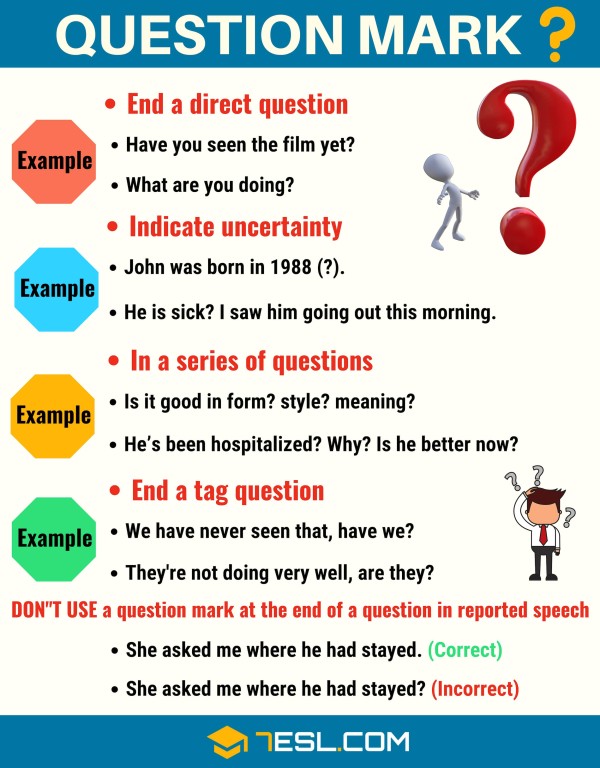
The question mark (?) indicates that a question is being asked directly in a sentence or phrase. For indirect questions, English uses a different device, explained below. Using question marks for indirect questions is a common mistake made by English learners.
The punctuation mark (?), when you stop to think about it, is an oddly shaped mark, and its origins and early history are not entirely clear. One theory is that it evolved from an early musical notation device intended to represent a rising tone.
PinQuestion Mark – Created by 7ESL
What Is a Question Mark?
A question mark is the bit of punctuation you add at the end of a question to indicate that you are actually inquiring about something. It looks like this ‘?’ and you add it whenever you ask a question in a bit of writing to show that a question has been asked.
When to Use Question Marks
We use a question mark to end a direct question.
Question marks end all direct questions in English.
Examples:
Have you seen the film yet? What are you doing? What is this? Are you happy? Is this your house? How much does it cost? Where do we go? Who is that girl? Do you like coffee?When you are changing a question from direct speech into indirect speech, you end the sentence with a full stop, not a question mark. Thus, don’t use a question mark at the end of a question in reported speech.
Direct questions:
She asked, “Where did he stay?” “Have you got a computer?“Reported questions:
She asked me where he had stayed. (Correct) She asked me where he had stayed? (Incorrect) He wanted to know whether I had a computer. (Correct) He wanted to know whether I had a computer?. (Incorrect)We use question marks to express uncertainty.
Examples:
You don’t know him? He’s your neighborhood. He is sick? I saw him going out this morning. John was born in 1988 (?).We use a question mark to end a tag question.
Question tags are used at the end of statements to ask for confirmation.
Examples:
We have never seen that, have we? They’re not doing very well, are they? He finished on time, didn’t he? I’m intelligent, aren’t I? There weren’t any problems when you talked to Jack, were there?We use question marks in a series of questions.
Examples:
Is it good in form? style? meaning? He’s been hospitalized? Why didn’t you tell me? Is he better now? Question Marks with Other PunctuationThe most common way that a question mark will be combined with other punctuation is with an exclamation mark. This indicates that a question is being asked whilst shocked or angry. When the two are combined, this is known as an interrobang. It is usually expressed as two separate punctuation marks ‘?!’ but there are some word processors that can allow you to combine the two. Here is how an interrobang would work:
What are you doing?! – the question mark usually comes first because that is the primary function of the sentence. The exclamation mark follows to indicate tone and the mood in which the question was asked.

Pin
How to Use Question Marks with Quotation Marks
Whether or not to put a mark (?) inside or outside a closing quotation mark depends on whether what’s inside the quotation marks is a question. If it is, put the question mark inside the closing quotation mark.
Susan asked, “Do you think it’s realistic to finish the project by Friday?” Every day, a soldier may face this question: “Is this the day I die?”If the quoted material is not asking a question, put the question mark outside the quotation mark.
Didn’t the boss say we have “15 minutes for a break, and not a minute more”?Remind me: which poem contains the line “I heard a fly buzz when I died”?
How to Use Question Marks with Parentheses
Parentheses work much the same way as quotation marks. If the question is being asked within the parentheses but not the whole sentence, then the question mark would appear within the parentheses to highlight this. If, however, the question was being asked as a whole and parentheses were being used to simply add more information, then the question mark would appear outside the parentheses. It would look like this:
Chad was looking at me (or was he?). – here the question is only being asked within the parentheses so it is inside the parentheses that the question mark must appear.
Was Chad looking at me (he might have just been avoiding looking at the sun)? – the question is asked as a whole so the question mark appears outside of the parentheses because the information provided within the parentheses isn’t a question, it’s just additional information.
Question Mark Quiz
All correct answers will be shown at the end. Simply decide if the following sentences or statements are correct or incorrect.
“Can we go to the cinema,” she asked? The following is an example of an indirect question: “Are you OK?” I think it’s raining out (or is it?). Is it raining out (the windows seemed wet but it could have been the leaky roof again)? The following is an example of a direct question: “Could you tell me if you’re OK?”Answers:
Incorrect. Incorrect Correct Correct Incorrect1)”Can we go to the cinema?” she asked. – this would be the correct answer because the question is asked within the quotation marks so the question mark must appear here too.
2)”Are you OK?” is a direct question. You could turn it into an indirect question by increasing the politeness and embedding the question within another question. Like this: “Can you tell me if you’re OK?”
3)This is correct because the question is asked within the parentheses only.
4)This is correct because the parentheses only serve to add more information to the question that is being asked, so the question mark must appear outside the parentheses.
5)”Could you tell me if you’re OK?” is an example of an indirect question. To be direct you would have to remove the “Could you tell me?” question and simply ask “Are you OK?”
网址:Question Mark (?) When to Use Question Marks in English • 7ESL https://c.klqsh.com/news/view/352516
相关内容
Happy Synonyms: 105+ Synonyms for Happy in English • 7ESLQuery vs. Question
“Within” and “in” when referring to time
Affect vs. Effect: Clear Up the Confusion! • 7ESL
Look! How to Get Help in Windows 10 (6 Ways Included)
How to Use DKS (Dynamic Keystroke)
Mastering 'Get Around': The Ultimate Guide to This Phrasal Verb
“Bated Breath” Meaning, Origin and Examples • 7ESL
How to kill suspended processes in Windows 10
query 的中文翻譯
随便看看
最新乐趣
- 每当有个别人家的孩子出现,都有一个傻白甜的小孩在瑟瑟发抖 黄渤 单禹豪
- 坂本为了得到绝世刀法亲手杀害下属 不料姐姐霸气为弟弟复仇
- 端妃是如何隐晦地贬低皇后,帮助甄嬛的?
- 原来兰香如故里面的女性角色都是草药!兰香如故 许兰香 冷知识
- 还有人不知道小卓大人有了......内丹吗
- 这个场景其实也很难受
- 甄嬛和槿夕的配合真的很有默契 三言两语就套出来翡雯的话不可信 10/19
- 翰哥一杯奶茶化解危机,汉王失信任于馨
- 看看,文潇大人这“美人计”够不够易如反掌?
- 郑国霖坦言初时忐忑如今深爱角色,蕴藏创作自由
热点乐趣
- 89531
- 77666
- 64107
- 59984
- 39687
- 34981
- 32053
- 22604
- 22150
- 21317