Verb: Definition, Types, Forms and Examples
Create a study schedule and stick to it. Allocate time for reading, writing, listening, speaking, and problem-solving exercises every day. #生活技巧# #英语学习#
Verbs are words that show actions, events, or states of being. In this lesson, you will learn the main types of verbs and how to use them correctly in English sentences.
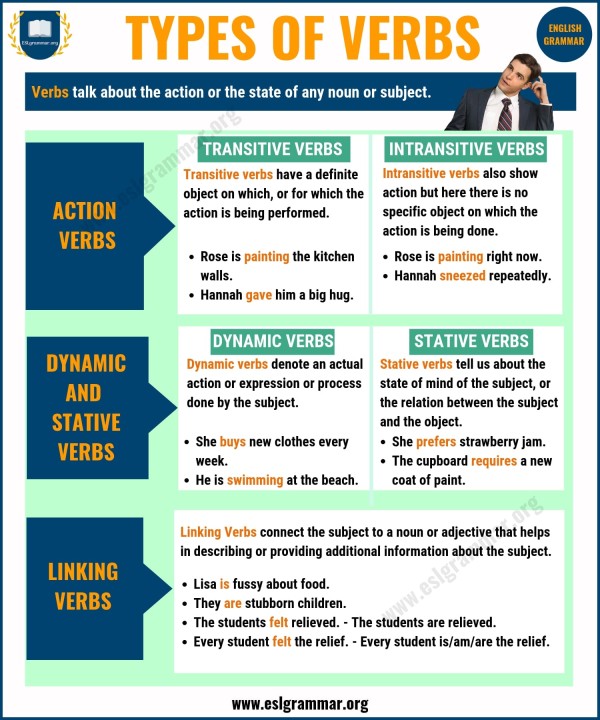
Table of Contents
What Is a Verb?Different Types of VerbsAction Verbs (Dynamic Verbs)Linking Verbs (Stative Use)Auxiliary (Helping) VerbsModal VerbsPhrasal VerbsVerb FormsBase and Main FormsParticiplesGerunds and InfinitivesImportant Grammatical AspectsMoods in EnglishVoice: Active and PassiveVerb Agreement with SubjectsPractical Exercises with answersWhat Is a Verb?
A verb, one of the key parts of speech, is a word or group of words that describe actions in their various forms. It can also be defined as a set of words that express three core elements: physical actions, mental actions, and states of being. To better understand these definitions, let’s look at an example.
Jane jumped through the window.Jane is the noun, and jumped explains the action she took.
The bus overturned at the main bridge on the way to town.In this example, the bus is the noun, and overturned describes the physical action.
Different Types of Verbs
Verbs can be classified by function in a sentence. Below are the main types: action verbs, linking verbs, auxiliary (helping) verbs, and modal verbs.
Action Verbs (Dynamic Verbs)
As the name implies, action verbs describe what someone or something does. They often express an action that can be seen or physically felt.
She buys new clothes every week. He is swimming at the beach.These verbs are often categorized into two groups: transitive and intransitive.
Transitive Verbs
A transitive verb has a direct object (a noun that receives the action).
She patted her dog’s tail.In this example, “patted” is the verb, and the noun that is being acted upon is “her dog’s tail,” which is the direct object.
To identify transitive verbs, you can ask: “What did the subject [verb]?”
Rose is painting the kitchen walls.Ask: “What is Rose painting?” → The kitchen walls.
So, painting is transitive here because it has a direct object.
Hannah gave him a big hug.Ask: “What did Hannah give?” → a big hug.
Here, him is the indirect object (Who did she give the hug to?).
Intransitive Verbs
An intransitive verb does not take a direct object. It may be followed by an adverb or an adverb phrase.
Jason walks swiftly away.In this example, “walks” is the verb, and “swiftly away” is an adverb phrase describing how he walks; there is no direct object.
Note: Some verbs (like paint) can be used with or without an object depending on the sentence. For a “clear” intransitive example, verbs like arrive, sneeze, and sleep are often better:
Hannah sneezed repeatedly. The baby slept soundly.Linking Verbs (Stative Use)
Linking verbs do not show action. Instead, they connect the subject to a noun or adjective that describes or identifies the subject. These nouns or adjectives are called subject complements.
Lisa is fussy about food. They are stubborn children.Here, is/are connect the subject to additional information (the complement).
Common linking verbs include: be (am, is, are, was, were), seem, become, feel, look, taste, smell, remain, stay, grow, and turn.
The best way to recognize linking verbs in a sentence is to see whether the verb can be replaced by ‘is,’ ‘am,’ or ‘are’. If the sentence still sounds logical, you likely have a linking verb.
The students felt relieved. – The students are relieved.Hence felt is a linking verb here because it connects the subject to an adjective.
Compare this with an action meaning:
Every student felt the relief. – Every student is/am/are the relief.Here, felt is an action verb because it describes the action of feeling something.
Dynamic vs. Stative (Important Note)
Some verbs can be used in different ways depending on meaning. Dynamic verbs show actions (work / build / play), while stative verbs describe states (believe, prefer, need). Also, some verbs can be either linking or action verbs depending on context (feel, taste, smell, look).
Auxiliary (Helping) Verbs
Auxiliary verbs (also called helping verbs) are used with a main verb to show tense, voice, or emphasis/negation. They “help” the main verb form a complete verb phrase.
The most common auxiliary verbs are: be, do, and have.
She is running. (be + present participle = continuous tense) They have seen that movie. (have + past participle = perfect tense) I do not know. (do-support for negation)Modal Verbs
Modal verbs are a special type of helping verb used to express ability, possibility, advice, permission, or necessity. Common modal verbs include: can, could, may, might, must, shall, should, will, would, and ought to.
Joyce must draft her biography. Her experience might be traumatizing for some of her buddies.Phrasal Verbs
Phrasal Verbs are combinations of verbs with prepositions or adverbs. They create a meaning different from the original verb. Examples include “give up” (stop trying) and “look after” (take care of).
Understanding verb forms is essential for grasping English grammar. Verbs can appear in different forms, each serving a unique grammatical purpose. Below are the main categories of verb forms.
Base and Main Forms
The base form of a verb is its simplest form. It’s often referred to as the root form. For example, run, jump, and be are base forms. These forms don’t have any endings like -ed or -ing.
The main form of regular verbs changes based on tense. For example, walk becomes walked in the past tense. Irregular verbs don’t follow this pattern. For instance, go becomes went in the past tense.
Examples:
Base form: see, talk, travel Past tense (irregular): saw, spoke, wentParticiples
Participles are verbs used as adjectives or to form verb tenses. There are two types: past and present participles.
Past participles usually end in -ed for regular verbs. For example, baked in baked cake. Irregular verbs have unique past participles like gone for go. Present participles always end in -ing, such as running in running water.These forms are essential for constructing perfect and continuous tenses.
Examples:
Past participle (regular): asked, arrived, believed Present participle: asking, arriving, believingGerunds and Infinitives
Gerunds and infinitives are verb forms that function as nouns.
Gerunds end in -ing and can act as subjects, objects, or complements. For instance, Running is fun uses running as the subject. Infinitives are the base form of verbs preceded by to. For example, in to run, to eat, and to play, the infinitives act as nouns or complements.Both are crucial for varied sentence structures and convey specific meanings based on their form.
Examples:
Gerund as subject: Swimming is enjoyable. Infinitive as object: I love to swim.Important Grammatical Aspects
Verbs play a crucial role in sentences, affecting the mood, voice, and agreement with the subject.
Moods in English
Verbs can express different moods that show the attitude of the speaker. In English, there are three main moods: indicative, imperative, and subjunctive.
The indicative mood is used to state facts or ask questions:
She is reading a book. Are you coming?The imperative mood gives commands or requests:
Close the door. Please sit down.The subjunctive mood expresses wishes, hypothetical situations, or actions that are not real:
If I were you, I would go. It is important that he be here.Voice: Active and Passive
Verbs can be in the active or passive voice, depending on how the action relates to the subject.
In the active voice, the subject performs the action:
The scientist conducted the experiment.In the passive voice, the action is performed on the subject:
The experiment was conducted by the scientist.Active voice is often preferred for clarity and directness. Passive voice can be useful when the action is more important than who performed it.
Verb Agreement with Subjects
Verbs must agree with their subjects in number (singular or plural) and person (first, second, or third).
For singular subjects, use a singular verb:
He runs every morning.For plural subjects, use a plural verb:
They run every morning.When the subject is a collective noun or a plural form like news that is treated as singular, use a singular verb:
The team wins.Pay attention to compound subjects connected by and or or. With and, use a plural verb:
Jack and Jill are going up the hill.With or, the verb agrees with the part of the subject closest to it:
Either the cat or the dogs are playing. Either the dogs or the cat is playing.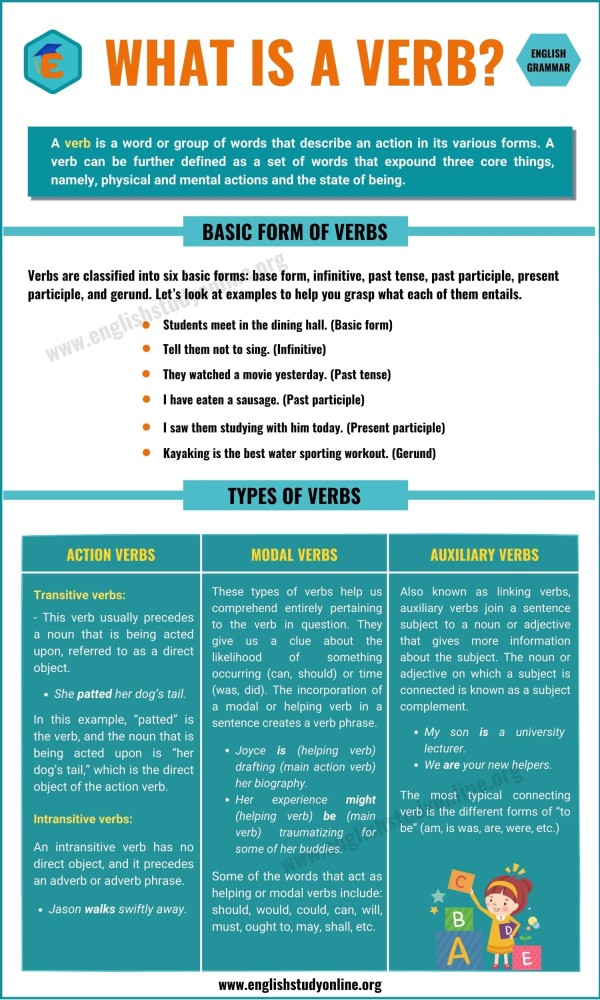
Practical Exercises with answers
When practicing verb usage, it’s essential to work through exercises. Here are some practical exercises along with their answers:
Exercise 1: Fill in the Blanks with the Correct Verb Form
If I ______ (know) it was your birthday, I would have bought you a gift. She ______ (read) that book multiple times. We ______ (eat) all the cookies before dinner. I wish I ______ (spend) less money last month.Exercise 2: Identify and Correct the Verbs
Read the sentences below and correct the verb form if needed:
He is go to the store. They have saw that movie already. She wish she has more time. If he studied harder, he might get better grades.These exercises will help you master verb usage. Keep practicing to improve your skills!
Answers
Exercise 1: Answers
had known has read had eaten had spentExercise 2: Answers
He is going to the store. They have seen that movie already. She wishes she had more time. If he had studied harder, he might have gotten better grades.Note: The original sentence is also grammatically correct as a second conditional, depending on meaning.
网址:Verb: Definition, Types, Forms and Examples https://c.klqsh.com/news/view/352667
相关内容
VERB Definition & MeaningVINDICATE definition in American English
Difference Between Affect and Effect (with Comparison Chart)
Affect vs Effect Explained with Uses and Examples
HATE
MICROCOSM definition and meaning
9+ Antonyms of Happy, Meaning and Examples
Jokes and pranks in Spanish: Spanish
What Are Verbs? (With Examples)
100 Examples of sentences containing the verb “get around”
随便看看
最新乐趣
- 真正有远见的父母,大都不允许女儿嫁这三类男人,原因很简单
- 传文为了学会炖鱼,特意灌醉鱼老板,套取秘方
- 《兰香如故》九皋玉蝉姐弟恋,小莲南客风雪求娶
- 折腰:魏劭跟小乔闹掰了
- 黄子弘凡说我没事
- 刘宇宁一开口就是江湖嗓
- 《一瓯春》混剪直接看呆众人!把谢清圆与严瑞之间拉扯宿命感全部浓缩在一起…
- 我的东北小狗哥哥
- 权志龙演唱会眼镜被头发勾住,舞者帮忙处理
- 兰花叶子枯黄,大爷神情慌张
热点乐趣
- 89534
- 77670
- 64109
- 59990
- 39691
- 35013
- 32060
- 22607
- 22162
- 21320